In modern industrial and energy systems, metal products must withstand a wide range of temperature loads – from severe frost to prolonged exposure to high temperatures. This is especially true for seamless stainless steel tubes used in power generation, the chemical industry, oil and gas processing, and aerospace engineering. Under such conditions, not only the mechanical properties of materials are critical, but also their ability to perform reliably under temperature extremes. Centravis, one of Europe’s leading manufacturers of seamless stainless steel tubes, offers materials adapted to these requirements through careful grade selection and standardized production processes.
Temperature Requirements in Industry: High and Low Operating Conditions
Metal tubes in industrial applications may operate under extreme conditions:
- High temperatures – in thermal power plants, heat exchangers, furnaces, reactors, and oil and gas processing systems, components are often heated to hundreds of degrees Celsius.
- Low temperatures – in cryogenic equipment, HVAC systems, and in the production and transportation of liquefied gases, materials must retain their mechanical properties at significantly reduced temperatures.
These requirements make the selection of steels with appropriate thermal characteristics a critical stage in the design of piping systems.
Which Centravis Steel Grades Are Optimal for High Temperatures
Centravis offers a wide range of steels capable of withstanding elevated operating temperatures:
High-temperature grades – such as 310S, 1.4845, 310Nb, 321H, and 347H – belong to steels with enhanced thermal stability and oxidation resistance during prolonged exposure to temperatures of approximately 900–1000 °C. These grades are used in:
- industrial furnaces and heat treatment units
- heat exchange systems operating under high-temperature cycles
- components of oil refining and chemical processes where materials are exposed to thermal stress
The increased chromium and nickel content in these steels promotes the formation of protective oxide layers on the surface at elevated temperatures, minimizing oxidation and reducing material degradation.
Grades for Low-Temperature Applications
Most austenitic steels used by Centravis (such as 304L, 316L, and 316LN) retain good ductility and impact toughness at reduced temperatures (below 0 °C), which is critical for applications in cold environments, cryogenic systems, or the transportation of liquefied gases.
This combination of corrosion resistance and stable performance at low temperatures makes these alloys versatile even in demanding operating conditions.
Nikopolium: A New Level of Temperature Adaptability
A separate category of Centravis materials is represented by Nikopolium NP 2205 and NP 2507 steels – engineered duplex and super duplex alloys specifically developed for operation over an extended temperature range. They combine mechanical strength, impact toughness, and corrosion resistance at a level close to nickel alloys, but at a significantly lower cost.
The key advantage of these materials is their stable performance within a temperature range from –60 °C to +350 °C, which significantly exceeds the capabilities of conventional duplex steels typically limited to 250–280 °C.
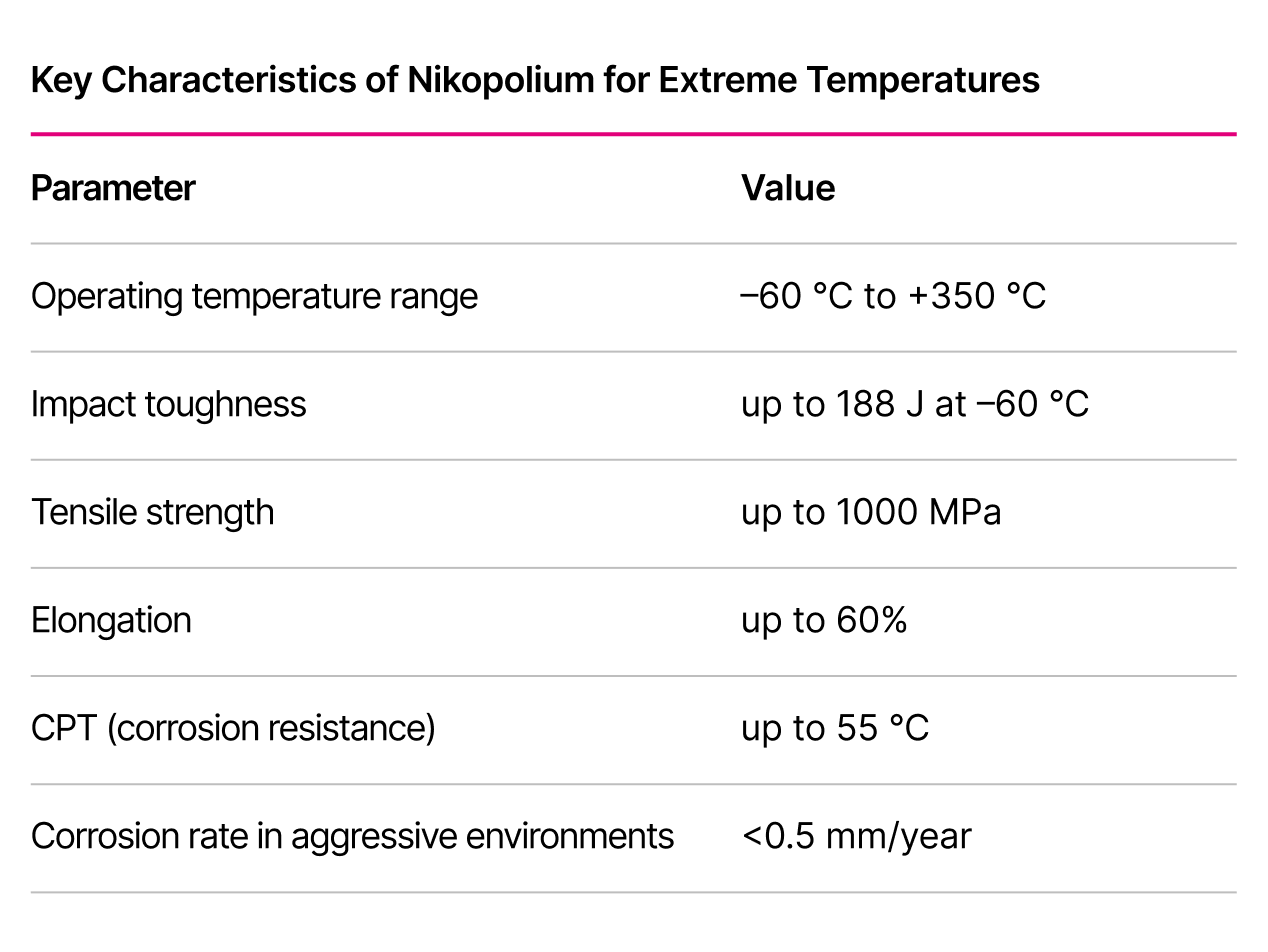
These characteristics make it possible to use the material in environments where high temperatures, aggressive chemicals, and mechanical loads are present simultaneously.
Where Nikopolium Delivers Maximum Performance. Nikopolium materials are particularly effective in the following applications:
- LNG and cryogenic systems – due to high impact toughness at –60 °C
- High-temperature heat exchangers and reactors – stable performance up to +350 °C
- Oil and gas industry (sour gas, CO₂, H₂S) – resistance to corrosion and pressure
- Hydrogen energy – resistance to hydrogen embrittlement
- Offshore and subsea structures – high mechanical stability in chloride environments
Microstructure That Drives Performance. The service life of tubes is determined not only by mechanical parameters, but also by the microstructure of the metal.
Nikopolium materials feature an optimized phase balance (approximately 45–55% ferrite and austenite), providing a combination of strength, ductility, and corrosion resistance. In addition, the structure includes high-angle grain boundaries (>15°), which prevent phase transformations and enhance stability at elevated temperatures.
This allows the material to retain its properties even under repeated thermal cycling.
Where Temperature-Adapted Centravis Tubes Are Used
Power generation and thermal cycles. Centravis stainless steel tubes are widely used in thermal power plants – in high-pressure boiler systems where materials operate at temperatures exceeding 500 °C. They are also suitable for heat exchangers, where continuous heating creates a risk of creep. Such applications require steels with enhanced thermal stability and mechanical strength.
Chemical and oil and gas industries. In complex oil and gas processing operations, tubes are exposed to high temperatures and aggressive environments, where thermal cycles and corrosive media act simultaneously. In such cases, specialized austenitic and nickel alloys with stable microstructures under heat are preferred.
Mechanical engineering. In the manufacture of components for high-temperature applications in mechanical engineering, such as turbine elements or heating systems, steel grades capable of withstanding significant temperature fluctuations are used.
How Centravis Ensures Adaptive Strength
Material stability under high and low temperatures depends not only on chemical composition, but also on production technology. Centravis applies advanced heat treatment methods and comprehensive quality control, confirmed by certification in accordance with international standards. This ensures that tubes maintain structural integrity and mechanical properties throughout their entire service life.
Conclusion
For modern energy and industrial systems, adaptive material strength is a key factor in reliability and efficiency. Centravis offers a wide range of steels that perform consistently under extreme high and low temperatures, thanks to careful grade selection, advanced processing, and strict quality control.
This approach makes it possible to develop tubing solutions for critical industries – from power generation and oil refining to mechanical engineering – with high durability, safety, and performance.