The aerospace industry is operating amid steady demand for air travel, while at the same time facing pressure on manufacturing and supply chains. According to IATA, in 2025 global passenger demand, measured in revenue passenger kilometers, grew by 5.3% compared with 2024, while available passenger capacity increased by 5.2%. This raised the average load factor to 83.6% – the highest annual figure ever recorded by IATA. In December 2025, total demand grew by 5.6% year on year, capacity by 5.9%, and the load factor reached 83.7%. Against this backdrop, manufacturers of aircraft engines and components continue to face shortages of critical materials, including titanium and nickel tubes, which puts additional pressure on aerospace supply chains.
Demand for tube solutions for aviation and space is supported not only by the growth of air travel, but also by fleet modernization and the development of fuel, hydraulic, cooling, and air systems. According to an updated estimate by Stratview Research, the global aerospace tubes market was valued at approximately USD 0.9 billion in 2026 and may grow to USD 1.3 billion by 2034, with a compound annual growth rate of 6.1%.
In such programs, a tube is not an auxiliary metal product, but part of a safety-critical system. It must be light enough not to increase the weight of the structure, strong enough to operate under pressure and vibration, corrosion-resistant, and stable across a wide temperature range. That is why, for aerospace applications, not only the steel grade or alloy matters, but also manufacturing precision, surface quality, geometry control, and batch-to-batch repeatability.
Where Tubes Are Needed in Aviation and Space
In aircraft, tube components are used wherever liquids, gases, pressure, or heat need to be transferred. These include hydraulic circuits, fuel lines, cooling lines, air supply systems, engine elements, control circuits, air-conditioning systems, and auxiliary units. According to Stratview Research, hydraulic and instrumentation lines retain the largest share of the aerospace tubes market, while seamless tubes remain the dominant product type due to their strength, reliability, and absence of risks associated with a welded seam.
In space programs, tubes may be part of ground infrastructure, test stands, fuel supply systems, cooling systems, pneumatics, high-pressure systems, or auxiliary circuits. Here, not only mechanical properties are important, but also the ability of the material to operate with aggressive media, temperature fluctuations, vibration, and cyclic loads.
Centravis manufactures seamless stainless steel tubes and tubes made from special steels for mechanical engineering, petrochemicals, the gas industry, shipbuilding, aerospace, and nuclear and thermal power generation. The company’s production includes hot-extrusion and cold-drawing shops, while its portfolio covers more than 1,000 tube sizes made from over 100 corrosion-resistant and heat-resistant steel grades.
Why Lightness Must Be Combined with Strength
In aviation and space, the weight of every component matters. A lighter tube system can reduce the load on the structure and improve efficiency, but weight reduction cannot come at the expense of safety. A tube must withstand pressure, vibration, temperature fluctuations, installation loads, and contact with the working medium.
That is why materials that combine strength, corrosion resistance, geometry stability, and durability are especially valuable. A seamless design has a separate advantage: it eliminates the welded seam as a potentially weak zone, which is important for systems operating under high pressure, dynamic loads, and increased reliability requirements.
Centravis Grades Relevant to Aviation and Space Programs
There is no single universal grade for aerospace applications. The choice depends on where the tube operates: in a fuel line, hydraulic circuit, cooling system, high-temperature unit, ground test equipment, or auxiliary infrastructure.
Balev 304L® and Balev 316L® may be relevant for systems that require a combination of corrosion resistance, strength, and ductility. These grades are an optimal solution for high-pressure applications where strength, corrosion resistance, and ductility must be combined. In addition, the ability to use thin-wall tubes without compromising safety provides economic advantages and helps reduce structural weight.
TP316LN / 1.4429 belongs to the group of austenitic stainless steels and may be useful where corrosion resistance, stable mechanical properties, and reliable performance in critical tube systems are required. In an aerospace context, this may include auxiliary circuits, ground equipment, cooling systems, or engineering units where a balance of strength, manufacturability, and environmental resistance is important.
TP321 / 1.4541 is associated with heat exchangers, furnaces for the chemical and petrochemical industries, as well as furnace fittings, muffles, retorts, nozzles, and exhaust manifold components. For aviation and space programs, this logic may be relevant for high-temperature circuits, test stands, hot gas removal systems, or auxiliary units where the material must remain stable during heating and cooling.
904L / N08904 / 1.4539 is used in corrosive conditions, including seawater and hard-water environments, condensers, heat exchangers, and gas scrubbers. In aerospace, such properties may be important for ground infrastructure, cooling systems, gas-cleaning systems, and equipment operating with humid or chemically active environments.
N06625 / Alloy 625 is a nickel alloy for demanding conditions where resistance to corrosion, oxidation, and high-temperature heating is required. Centravis recommends nickel alloys for use in critical industries, including aerospace, energy, and petrochemicals. For aviation and space applications, N06625 may be relevant in high-temperature or corrosion-active circuits, test systems, and units with increased durability requirements.
Examples of Tube Applications in Aerospace
One of the most illustrative examples of Centravis products being used in the aerospace sector is the supply of tubes for SpaceX. In 2024–2025, the company supplied 107.5 tonnes of tubes intended for use in fuel systems. The total length of the ordered products was 5,300 meters. This project demonstrates that Centravis seamless tubes can meet the requirements not only of traditional industrial sectors, but also of high-tech aerospace programs.
In aerospace systems, seamless tubes and special stainless materials are used not as universal blanks, but as part of specific functional units. These include cooling systems, fuel lines, and hydraulic lines, where the material must withstand temperature, vibration, pressure, and strict weight limitations at the same time. Under such conditions, stable tube quality directly affects system service life: it helps reduce the need for maintenance, extend equipment life, and lower the total cost of ownership.
A separate area is hollow bars for machining. They are used when precise cylindrical components or complex parts with controlled geometry need to be produced from a tubular blank. Such solutions may be relevant not only for aerospace, but also for electronics, medicine, defense, transport, chemistry, and petrochemicals. For component manufacturers, this means a predictable material structure, stable dimensions, and the ability to perform further machining according to the requirements of a specific unit or system.
How the Properties of Centravis Tubes Support Aerospace Projects
For aviation and space, what matters is not a single property, but a combination of parameters. The first is strength at the lowest possible weight. If a tube can operate with a thinner wall without compromising safety, it helps reduce system weight. The second is corrosion resistance: aerospace systems may operate with fuel, working fluids, condensate, gases, aggressive media, or marine atmospheres. The third is thermal stability, which is necessary for engine, test, high-temperature, and gas systems.
Precision and repeatability are no less important. The Centravis product portfolio includes hot-finished tubes with an outside diameter of 56–250 mm, wall thickness of 3.05–43 mm, and lengths of up to 15 m, as well as cold-finished tubes with an outside diameter of 6–114 mm, wall thickness of 0.7–12 mm, and lengths of up to 27 m. For the aerospace industry, this matters because different systems require different diameters, wall thicknesses, lengths, tolerances, and further processing.
Why the Material Must Be Selected for the Specific System
There is no universal “aerospace” material for all tube applications. For a hydraulic line, pressure, fatigue strength, and precision are important; for a fuel line, compatibility with the medium, surface cleanliness, and connection reliability matter; for a cooling system, heat transfer, corrosion resistance, and geometry stability are critical; for a high-temperature or test unit, heat resistance, oxidation resistance, and thermal fatigue resistance are required.
That is why the choice between Balev 304L®, Balev 316L®, TP316LN, TP321, 904L, or N06625 should be based not on the grade name, but on operating conditions. Engineers need to consider operating temperature, peak modes, pressure, the medium inside the tube, external factors, vibration, weight requirements, standards, quality control, and service life.
Conclusion
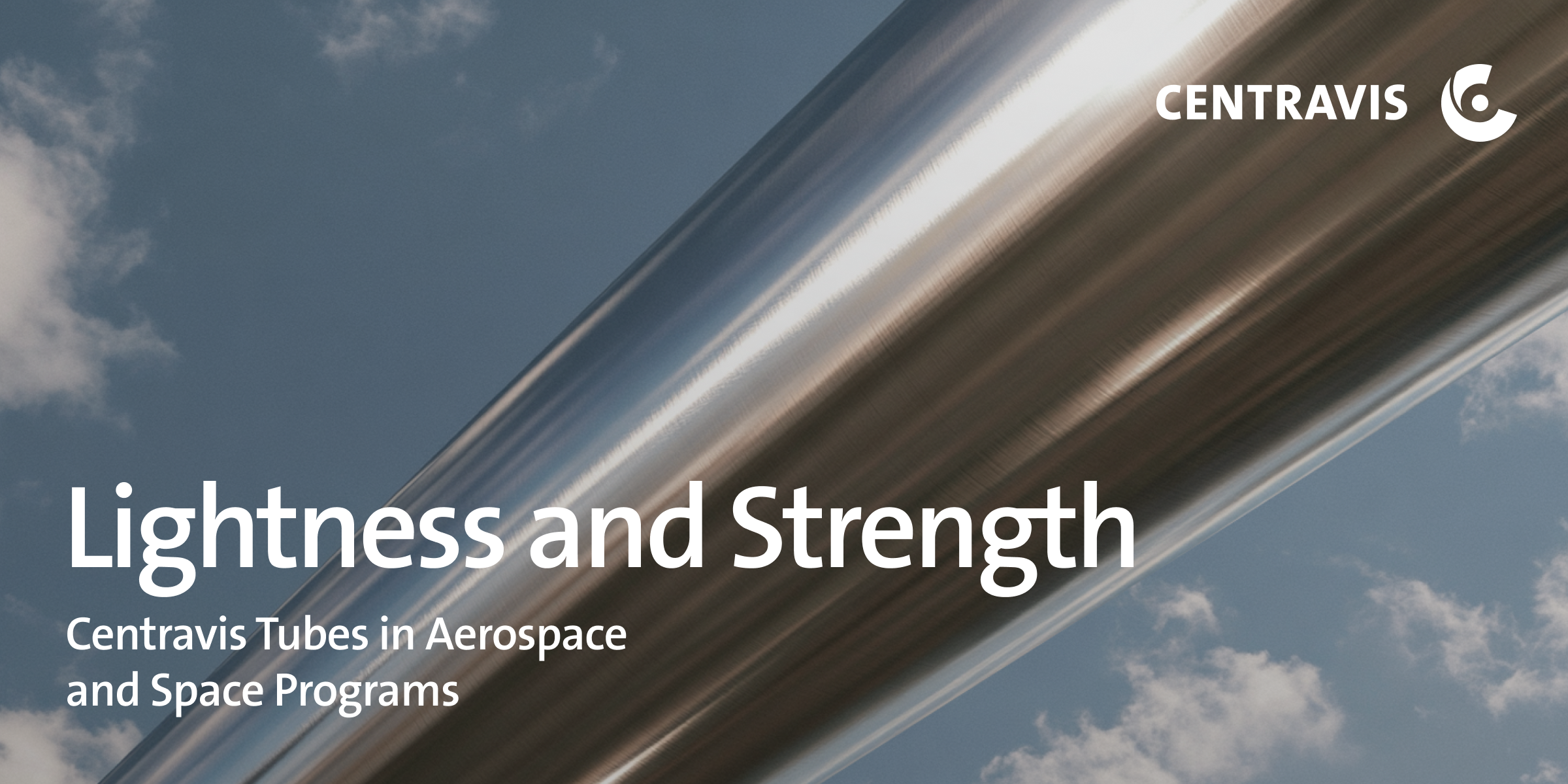
Aviation and space programs require tubes that combine lightness, strength, corrosion resistance, thermal stability, and precision. Amid growing air traffic, aircraft fleet modernization, and shortages of critical materials, a supplier of tube solutions must be more than a manufacturer – it must be an engineering partner capable of working with different grades, sizes, and reliability requirements.
Centravis tubes may be relevant for such tasks thanks to their seamless design, broad portfolio of austenitic, high-alloy, and nickel materials, experience in supplying products for critical industrial applications, and an officially confirmed example in the aerospace sector – the supply of thick-wall seamless stainless steel tubes for SpaceX. For an industry where every gram, every tolerance, and every production risk matters, this is the practical meaning of the formula “lightness and strength.”