Modern industrial systems increasingly depend on materials capable of operating under complex and changing conditions. In power generation, petrochemicals, mechanical engineering, and aerospace industries, tubular products must withstand exposure to high temperatures, aggressive environments, and significant mechanical loads over long periods of time. Under these conditions, heat treatment is no longer merely a technological stage of production — it becomes a key tool for shaping the properties of steel.
Until recently, traditional heat treatment approaches provided a basic level of strength and stability. However, modern material requirements have become more demanding. The decisive factor is now microstructure control, as it determines how steel behaves under load, how it resists corrosion, and how long it retains its properties in operation.
What Role Heat Treatment Plays in Tube Properties
At the micro level, heat treatment changes the internal structure of the metal. Heating and cooling processes affect grain size, phase composition, and stress distribution within the material. The balance between strength, ductility, and corrosion resistance depends on how precisely these parameters are controlled. This is why modern heat treatment technologies involve controlled temperature regimes, thermomechanical processing, grain boundary engineering, and the use of automated process control systems.
Through such approaches, steel acquires new properties. It becomes more resistant to fatigue, better withstands aggressive environments, and maintains stability at both high and low temperatures. The risk of intergranular corrosion is reduced, which is especially important for tubes operating under critical conditions. An example of this approach is Balev Steel technology, where optimized heat treatment provides a combination of high strength and long-term durability.
Characteristics of Steel Grades
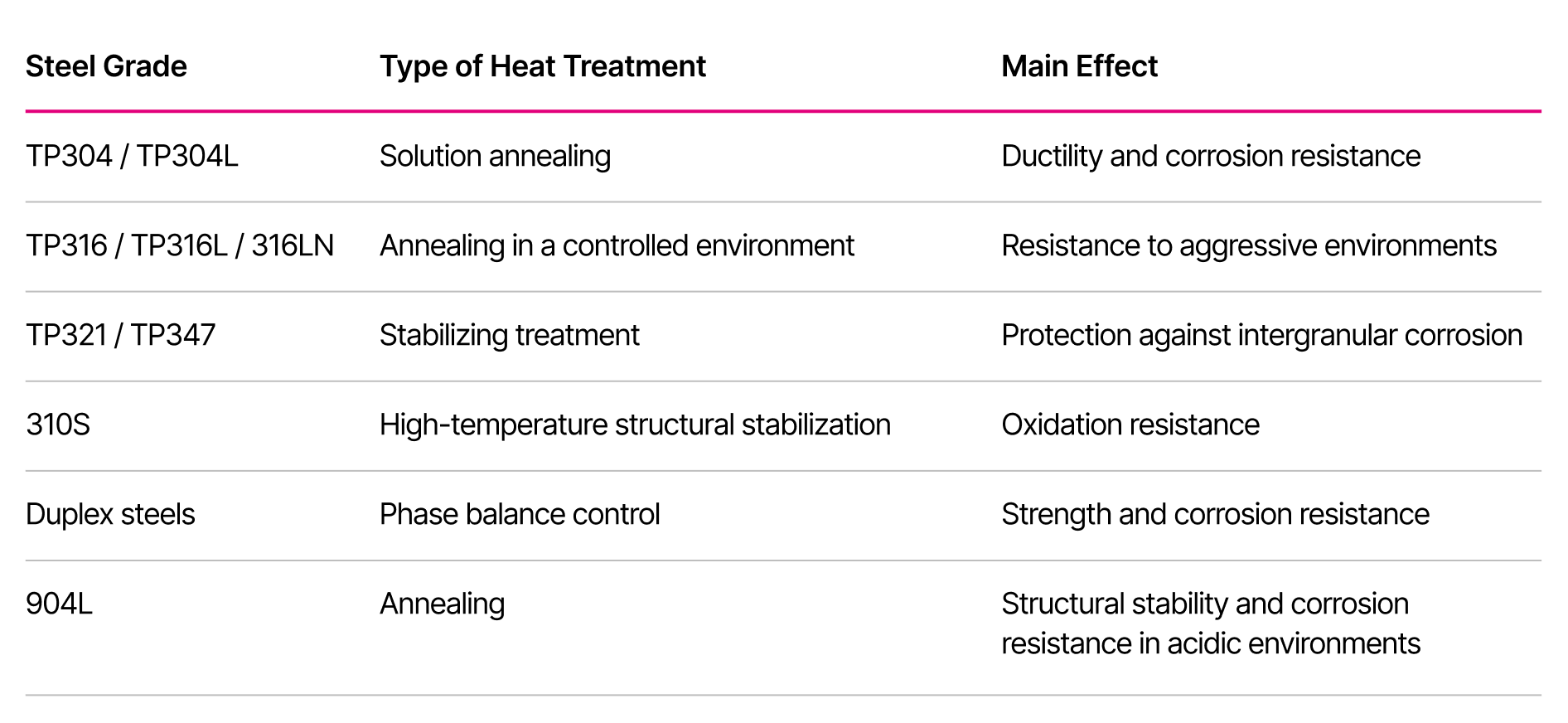
It is important to understand that heat treatment is not applied in the same way to all steels. Different grades require different regimes and approaches. Austenitic steels such as TP304L or TP316L undergo solution annealing, which ensures their corrosion resistance and ductility. For stabilized grades, including TP321 and TP347, solution annealing is applied, while resistance to intergranular corrosion is achieved through alloying with titanium or niobium. High-temperature steels such as 310S require treatment that allows them to maintain operational stability at temperatures up to approximately 1000 °C.
Duplex and super duplex steels represent a separate category. In these materials, heat treatment is used to precisely control the ratio of austenite and ferrite phases, which determines their mechanical strength and resistance to stress corrosion cracking. For special alloys such as 904L, heat treatment ensures stability in acidic environments, which is critical for the chemical industry.
These differences can be summarized as follows:
The practical significance of these processes becomes evident in real operating conditions. In thermal power generation, tubes operate under constant heating conditions where creep resistance is critical. In the oil and gas industry, they come into contact with aggressive environments under high pressure. In mechanical engineering and hydraulics, tubes are subjected to cyclic loads, while in aerospace applications they must also meet minimum weight requirements.
Economic and Environmental Advantages of Heat Treatment
Modern heat treatment technologies not only improve material reliability, but also influence project economics. Increased strength makes it possible to use thinner tube walls, reducing structural weight and material consumption. A longer service life means fewer shutdowns and repairs, resulting in a lower total cost of ownership.
The environmental aspect is equally important. Modern heat treatment technologies make it possible to reduce production energy consumption and lower CO₂ emissions. Rational use of alloying elements and improved product durability make such materials an important component of sustainable industrial development.
Thus, heat treatment today is not merely a stage of production, but a strategic tool of materials engineering. It enables the transition from standard steel to materials with tailored properties adapted to specific operating conditions. This is precisely the approach implemented by Centravis, establishing a new level of quality and creating opportunities for the development of the industry of the future.