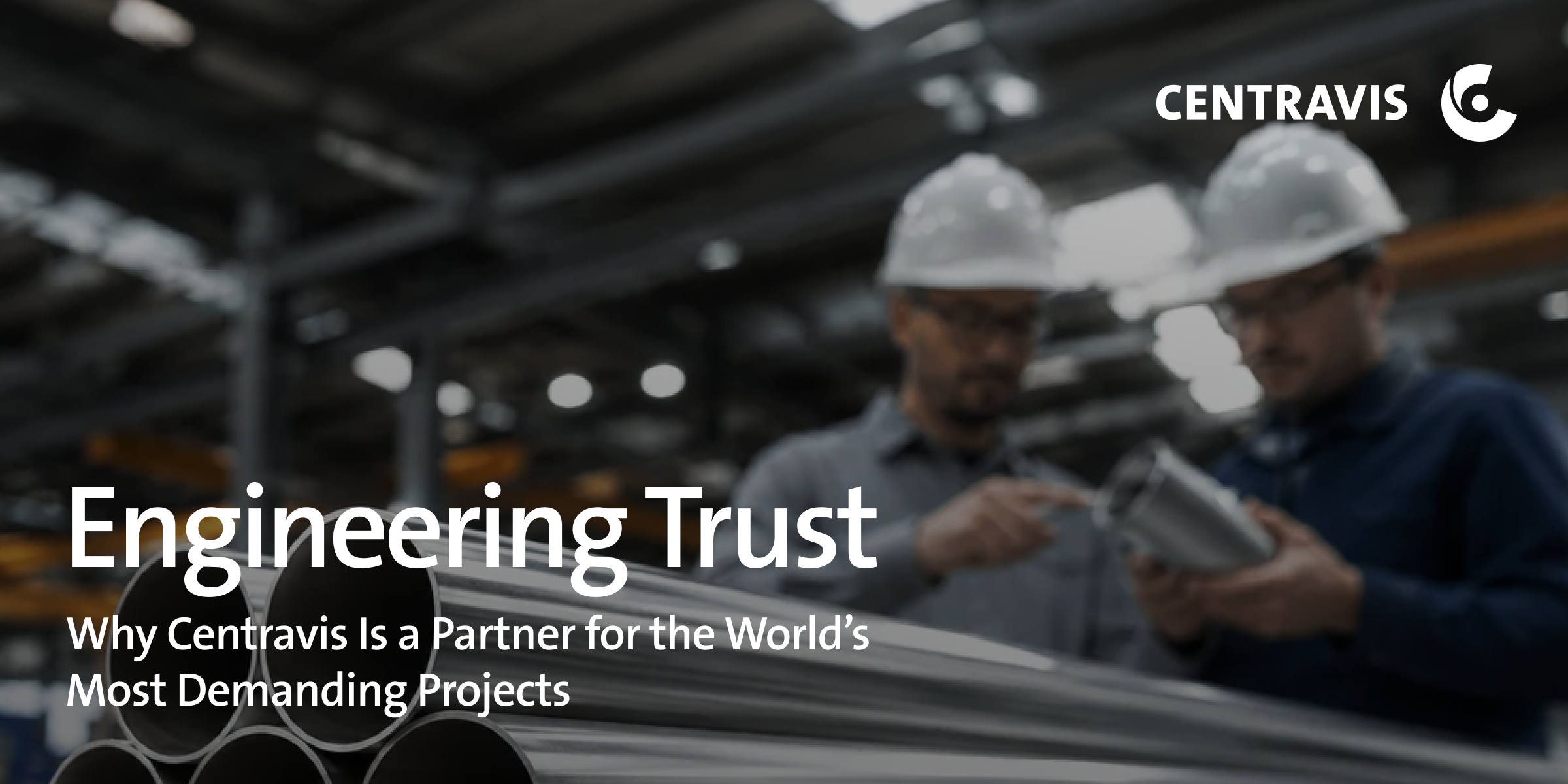
In global industry, trust in a supplier is built not on marketing promises, but on the ability to consistently meet the requirements of the most complex projects: automotive fuel systems, nuclear power, oil and gas infrastructure, the chemical industry, hydrogen technologies, and the energy of the future. For these sectors, a seamless stainless steel tube is not just a metal product, but an element of safety, service life, and technological predictability.
Centravis operates precisely in this segment: the company manufactures seamless stainless steel tubes and tubes made of special steels for mechanical engineering, petrochemicals, the gas industry, the aerospace sector, nuclear power, and thermal power generation. Production includes hot extrusion and cold drawing shops, while the portfolio covers more than 1,000 tube sizes made from over 100 corrosion-resistant and heat-resistant steel grades.
Trust Begins with Critical Applications
The most demanding customers choose a supplier based on far more than price. For them, dimensional stability, surface quality, batch-to-batch repeatability, production traceability, certification, engineering support, and the ability to pass audits are essential. In this sense, Centravis competes not simply as a tube manufacturer, but as a technology partner for projects where a material failure or delivery delay can affect the safety of the entire system.
Centravis structures its work around these exact requirements. This is confirmed, among other things, by ISO 9001:2015 for its quality management system, NORSOK M-650 for seamless tubes made from duplex and super duplex grades, as well as API Spec Q1 and API 5 CRA certifications obtained in 2026 for OCTG and CCUS projects. It is this combination of production discipline, international approvals, and the ability to work to the requirements of a specific project that explains why Centravis is chosen by global brands and industrial companies.
Case 1. Automotive Industry: BMW, Volkswagen, Porsche, Audi, Mercedes, Opel, Ferrari
The automotive industry is one of the best tests of production discipline. Fuel rails, high-pressure lines, hydraulic systems, and engine components require tubes with extremely precise dimensions, a stable surface, and controlled mechanical properties. Even a slight deviation in diameter or wall thickness can affect pressure, fuel delivery, component durability, and engine environmental performance.
BMW representatives audited the Centravis production line in Nikopol and assessed it as meeting the requirements for manufacturing seamless tubes for fuel rails. The transition from the audit to the first serial delivery took about a year, which reflects the level of verification typical of the automotive industry. Later, Centravis products were used in projects for Volkswagen Group, Mercedes, and Opel, and were also applied in vehicles made by BMW, Volkswagen, Porsche, Audi, Chevrolet, and Ferrari. For this segment, key factors include stable tube geometry, surface quality, batch-to-batch repeatability, and the supplier’s ability to operate within strict technical and audit procedures.
This case is important not only because of the well-known brand names. It shows that trust is built through joint engineering: Centravis notes that its engineers work together with automotive company engineers to update and improve the quality of tubes and, consequently, the components made from them. For the customer, this means not just receiving a material, but involving the supplier in improving the final component.
Case 2. Nuclear Power: Hinkley Point C, Buhlmann, and Bilfinger
Nuclear power is an industry where material quality is verified with particular rigor. What matters here is not only chemical composition and mechanical properties, but also compliance with standards, control of production procedures, documentation, surface quality, and tolerance stability.
Centravis passed a Buhlmann audit for the supply of tubes for nuclear power plants in Europe. Since 2019, Centravis has undergone annual audits as a supplier of products for nuclear power plants, and since 2020, 472 tonnes of tubes manufactured to EN and RCCM standards have already been supplied for the Hinkley Point C project in the United Kingdom.
During the final inspection of tubes for the Hinkley Point C BOP order, Centravis products were accepted by Buhlmann and Bilfinger for further use in the nuclear industry. The inspection covered compliance with RCCM and EN requirements, as well as parameters that are critical for nuclear projects: the quality of the external and internal surfaces, dimensional accuracy, and tolerance stability. Following acceptance, the high level of tube execution and minimal deviations from specified parameters were noted, confirming the product’s readiness for use in infrastructure with elevated requirements for safety and quality control.
This case clearly shows what “engineering trust” means in practice. For a nuclear project, it is not enough to manufacture a tube of the correct size. It is necessary to prove that production, quality control, procedures, personnel, and documentation meet the requirements of an industry where safety is the absolute priority.
Case 3. Oil and Gas Sector in the UAE: ADNOC Group, ADCO, ZADCO, ADMA-OPCO
Oil and gas projects in the Persian Gulf are often associated with high pressure, corrosive environments, hydrogen sulfide, marine conditions, and strict reliability requirements. In such conditions, supplier qualification by major energy companies effectively becomes a permit to enter the market for critical applications.
Centravis qualified with ADCO and ZADCO, and also received conditional qualification from ADMA-OPCO for the supply of instrumentation tubes for projects of companies within ADNOC Group. For the UAE oil and gas sector, this is particularly important because such applications are often associated with offshore conditions, high hydrogen sulfide content in fluids, and increased requirements for the corrosion resistance of materials. The Centravis product line includes special stainless steels with high nickel and molybdenum content, designed for operation in aggressive environments. The company later also passed ADCO prequalification for the supply of seamless stainless steel tubes in all grades, confirming its ability to meet the requirements of one of the key oil and gas operators in the UAE.
This example demonstrates another aspect of trust: the ability to meet end-user requirements in regions where the market had long been occupied by global competitors. For Centravis, this is not merely a sale, but confirmation that a Ukrainian manufacturer can meet the requirements of international oil and gas operators.
Quality as a System, Not a Final Inspection
In complex projects, quality cannot be “added” at the end of production. It is formed at every stage: from selecting the steel grade and deformation parameters to heat treatment, geometry control, surface condition, non-destructive testing, mechanical testing, packaging, and logistics. For the customer, this means that tube stability depends not on a single final inspection, but on the controllability of the entire production cycle.
The Centravis production model combines hot extrusion and cold drawing operations, enabling the company to work with a wide range of sizes, steel grades, and requirements for the finished tube. This is especially important for projects where a standard solution is not enough: material, dimensions, tolerances, surface, and control procedures must match the specific environment, temperature, pressure, and regulatory framework.
This approach turns quality into an engineering system. What matters in it is not only the characteristics of the finished product, but also process repeatability, batch traceability, control discipline, and the ability to confirm compliance with customer requirements at every stage. This is what matters in industries where a tube becomes part of critical infrastructure, and supplier reliability is evaluated as carefully as the properties of the material itself.
Production Technologies: Precision, Materials Science, Heat Treatment
For the most demanding projects, the steel grade is not the only thing that matters; how the tube is manufactured is equally important. For example, in the automotive segment, Centravis emphasizes the role of hot extrusion and cold drawing, which make it possible to achieve high dimensional accuracy and surface stability — critical parameters for high-pressure fuel systems in modern engines.
A separate area of Centravis development is work with materials for new and more complex operating conditions. This is not only about expanding the product range, but about creating solutions for industries where tubes must withstand a combination of corrosive environments, high temperatures, pressure, cyclic loads, and increased service-life requirements.
In this context, the development of extrusion technologies and work with special alloys are particularly important. In particular, Centravis is expanding its range of nickel alloys used in power generation, the nuclear industry, chemical processing, petrochemicals, hydrogen infrastructure, and marine environments. Such materials are needed where standard stainless steels no longer provide a sufficient margin of corrosion resistance, high-temperature strength, or stability.
This shows that the company develops its portfolio not only around current market demand, but also with future engineering challenges in mind. For customers, this means access to material solutions that can be selected for a specific project: from traditional industrial applications to clean energy infrastructure, CCUS, hydrogen, and high-temperature processes.
Environmental Aspect: Longer Service Life, Clean Energy, Hydrogen, and CCUS
In industrial materials, environmental performance often begins not with a “green” label, but with service life and reliability. If a tube operates longer in an aggressive environment, requires fewer replacements, reduces the risk of leaks, and shortens downtime, this already affects the overall environmental profile of the facility.
Centravis links its solutions to the transition to clean energy. The company notes that reliable materials play a key role in decarbonization, because the safety, durability, and efficiency of energy systems directly depend on them. In its approach to tube production, Centravis combines engineering precision, technological flexibility, and environmental responsibility.
Customer Focus: Not Only to Manufacture, but to Prove, Adapt, and Deliver
In high-tech B2B projects, customer focus is not limited to a quick response from a manager. It means the ability to pass an audit, adapt processes to customer requirements, provide documentation, support engineering communication, and deliver within agreed timelines.
The automotive case shows how Centravis restructured internal processes to meet industry requirements: the company formed a dedicated automotive group, conducted internal tests, prepared separate rolling mills, and purchased a special saw for cutting tubes into small sizes. This is an example of customer focus at the production level, where it is not the presentation that changes to meet the needs of the segment, but the process itself.
In the nuclear segment, customer focus is reflected in regular audits, a project team, control of procedures, and work with the requirements of previous inspections. During the Buhlmann audit, progress was noted in closing previous observations and in the engineering development of Centravis; the company linked these results to investments in equipment and modernization of its shops in 2020–2021.
For projects with tight schedules, product quality is not the only priority; supply predictability is just as important. The Fast Lane logistics initiative is focused precisely on this: it provides for a shortened delivery time for tube products to partners in Germany, Italy, and the AMEA region — around four weeks. For customers in complex industrial projects, this speed and stability of supply affect the planning of installation, commissioning, and equipment servicing, and therefore become part of the supplier’s overall reliability.
Why Centravis Is Chosen for the Most Complex Projects
Partnership in critical industries is always built on several layers of trust. The first is material-related: the tube must match the environment, pressure, temperature, and service-life requirements. The second is production-related: the supplier must ensure stable quality from batch to batch. The third is regulatory: certification, audits, and documentation must confirm the product’s suitability. The fourth is project-related: the company must work with the customer not as a seller, but as an engineering partner.
The cases involving BMW and Volkswagen, Hinkley Point C through Buhlmann and Bilfinger, and qualifications with ADNOC Group companies show that Centravis has passed verification precisely in such conditions: where the customer evaluates not only the tube, but the entire system — from production and control to service and readiness to meet industry requirements.
Conclusion
Engineering trust is the supplier’s ability to remain predictable where a project leaves no room for accidents. For Centravis, this trust is built through seamless tube production technologies, a broad portfolio of steel grades and nickel alloys, international certifications, experience in automotive, nuclear, oil and gas, chemical, and energy projects, as well as readiness to adapt processes to customer requirements.
That is why Centravis should be viewed not only as a tube manufacturer, but as a partner for engineering systems where material quality, production control, delivery times, and responsibility for the result are of strategic importance.